Did you know we have to teach children? *gasp* I know, right? They don’t know everything? They don’t learn everything by watching? They don’t come with a manual of “how to be a good person” written in gibberish that is there to study and matures as they do?
Now, before you storm off or attack me, I promise, there’s a point. And, as per usual, it includes my own learning curves.

And on that note, many of us have heard the familiar verse in Proverbs (ch22 vs6), “Train up a child in the way he should go, and when he is old he will not turn from it”. But a conversation with a co-worker made me reflect on this with a slightly new – or perhaps widened – perspective.
We were chatting and joking about our same-aged children, our then five-year-olds – and mannerisms, respect, and even just plain old behaviors. The conversation quickly turned into areas we’d not thought of having to teach – you know, in the “before we were parents” era. Things like greeting someone before asking them a question, acknowledging a person as they enter the room, not running in front of someone and cutting them off. That sort of thing. Sure, we all know that children need to be taught to walk, talk, hold a spoon, tie a shoe, write their names. But sometimes, we forget about the things with more depth, and the intentionality it requires to truly teach a child.
As I reflected on this conversation, I began an entirely new pondering on the old phrase, “it takes a village”. We often use it to imply to lend a hand, help out, do different tasks or chores or errands or take care of a child. Practical, hands-on behaviors. Right?

But I think it’s more than that. No, that’s not true. I know it’s so very much more. I listened to a training about bullying and trauma in schools, and she talked about how, time and again, she would hear the similar responses from school staff she would train…”it’s not my role”. But she wasn’t content with that – she repeatedly emphasized that no, actually, it’s ALL of our roles. It’s our role to step in as the adult when we overhear a complete stranger’s child bullying another child on the playground. It’s our role when we’re at the neighborhood pool and we see a child being pushed under by an older one. It’s our role to step in – even with presence – when we see a child being abused, hear teasing, see bullying, watch aggression and intimidation, contemplating stealing, cheating…who else’s role would it be?
Taking it back to our village, I believe we have so much to offer when we allow a village to pour into our children – to redirect a toddler hellbent on running into a road, to distract a preschooler from a tantrum as the exhausted parent looks around desperately, to even offer a compassionate, “I got you”, look to a stressed parent trying to keep her calm. We have so much to offer each other, and it takes so little. But too often, we’re content to take a passive role. One that says, “I don’t know them. What about the consequences? What about retaliation? Would they laugh at me? Not even listen? Judge me?” We get stuck in our own fear, our own hesitation, and we become tunnel visioned on the short term effects. But in doing so, we shut down that voice that says, “It’s the right thing. What if I’m the first adult who’s aware? What does it really matter if a teen scoffs at me or a toddler doesn’t listen or a parent becomes upset?” It’s our role as adults to protect the safety and innocence of children. And we shouldn’t – we can’t – shy away from it.
Generally speaking, this applies in so many different scenarios. But so often, we forget the message we send through our own passivity or desire to not be “the mean one”. If my child is acting out and I’m not aware or present, the passivity of the nearby adult teaches my child that they only need to behave if I’m around. If I have rules that others don’t, my child learn that rules are relative (and they are, but you get the point). If I allow things to happen in my presence, my child learns that I don’t *care* (used ever so lightly) about the results or end-game. If I am blamed for the reason my child can’t do something at your house, you take away your own power and respect. If I don’t follow through, I take away mine.
Some kids are internalizers by nature. Others are not. Some have intrinsic (self) motivation, others are motivated by extrinsic (external) factors. We can’t force either of those types of children to become the opposite – I have one child who will do extra chores to earn extra stickers to earn extra rewards. She’s been like that since we were potty-training at 2. I also have a child who could care less in the moment about whether or not she’s earning or losing a reward – she’s more motivated by what she thinks is important and the creativity is required to help her find “what’s in it for her”.
We also can’t force kids to not be kids…by nature, kids learn by repetition. They learn by patterns. Watch a 2 or 3 year-old, and you’ll see repetitive, monotonous, patterned behavior – they want to explore to see if the same result will happen every time. They go to one parent, then they other. The forge an obstacle course of sorts, then do it again and again and again. They throw food on the floor, and look at you. They try out behaviors. And look at you. They want consistency, and they are learning to make sense of their worlds. Kids are survivors. And knowing what to expect and where to expect is a very large part of that.
Along the same lines, somewhere we forget that after toddler-hood, kids continue to need this repetition. We think if we teach them something, they’re good for life. But even reading this, I’m sure you immediately think, “that’s not how it works”. Most children forget within about five minutes (yes, made up statistic – I own it – but I did hear something similar, I just can’t quote it directly because I have forgotten where…). They are learning so many things, and at younger ages, that learning is concrete. Not hypothetical. Not abstract. It’s through trial and error and exploration. And a parent can’t (shouldn’t…) follow them around, reinforcing every time the child is disrespectful or dishonest or makes a dangerous choice.

But if you agreed, “that’s not how it works”, you’re right. It’s not! We need to step in – as a village – and reinforce morals and values of human life, dignity, and respect. It can’t be done JUST by a parent, JUST by a doctor, JUST by a teacher, or JUST by a friend. Believe it or not, we don’t have to believe the same things to step in. But we do need to believe that there are certain lines that should not be crossed. We do need to reinforce that an adult being around makes a difference. If those children are anything like mine, when they’re young, they’ll come home and ask why it was different at so-and-so’s, or will tell you straight out what they did, often out of curiosity of what you’ll do if they broke the rules somewhere else. Don’t wait until they’re old to start teaching. We have so many children looking for boundaries. <3
P.S. I can’t speak to it personally, because I have not had the chance to fully check it out. But the trainer I listened to mentioned the Bystander Revolution – there are a lot of hits on YouTube. I’d love for you to check it out with me!


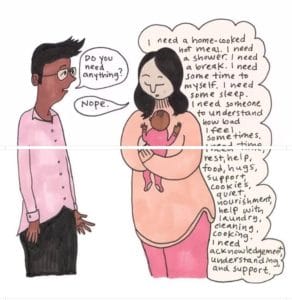 There’s a song that’s hit my heart many times, knowing full well the countless times that I’ve been both the offerer and receiver. In ‘Shine the Light’, Babbie Mason sings, “In the parking lot of the coffee shop, Just the other day. She smiled and she said, “Well I’m doin’ okay” But I felt her pain. I took her hand in mine, Said, “It’s gonna work out fine”. But as she turned I wondered, did I just hand her a line?” We pat ourselves on the back, *hopefully* lift up the prayer we promised, and move on our way.